Tuesday, August 18, 2026

Lex Anteinternet: The 2026 Election, 20th Edition. Primary Voting Commences Edition. Vote like your future and that of your state depends on it, because it does, part four.

Lex Anteinternet: The 2026 Election, 20th Edition. Primary Voting Co...: Governor's seal. When I started this thread and entered what is now the fourth part of what was supposed to be the last pre primary edit...

The 2026 Election, 20th Edition. Primary Voting Commences Edition. Vote like your future and that of your state depends on it, because it does, part four.

Governor's seal.

When I started this thread and entered what is now the fourth part of what was supposed to be the last pre primary edition, I had no idea that there's be so many posts in that relatively short amount of time.

It's been a busy primary, including a busy final couple of weeks in the primary.

The election is Tuesday.

There's a lot at stake.  Indeed, it wouldn't be exaggerating too much to say everything's at stake.  The GOP dominates in Wyoming and the Republican primary will determine if the state goes into the fully delusional right, or pulls back, gets a strong cup of coffee, and wakes up to what's happening.  So far, it's pretty clear the MAGA wing of the GOP hasn't done that.

I voted for:

Governor:  Barlow.

Senate:  Mead

House of Representatives:  Christensen.

Secretary of State:  Short.

Superintendent of Public Instruction: Harshman

There are some candidates that really need to be sent packing this election, which doesn't mean they will be.  Earlier editions of this series discuss those people, often in depth.

One prediction on packing.  If Chuck Gray loses, and I sincerely hope he does, he'll leave the state.  There's nothing to hold him here in the first place, and he truly isn't one of us.

That's been the focus of a late mailer and some television ads.  This election cycle has featured both in unprecedented levels.  Quite a few of them are disgusting, dealing in lies and half truths, but a few do hit home.  The late one on Gray being from Los Angeles, educated in a prep school, and then going to Wharton is one.  Anyhow, the money wasted on this election cycle is absolutely unconscionable.  Multimillionaire Steve Friess is flooding the zone with them and ought to lose for that reason alone.

Well, this really will be the last of this edition, and it'll be short.  We'll start a new one Wednesday, after the primary.

August 17, 2026

Wyoming Public Radio reports almost all of the Freedom Caucus members who received checks in Checkgate cased them.

As of Friday, who candidate still hadn't reported on his campaign finances.

Wyoming Debrief: August 17, 2026

August 18, 2026

This will be the last day for this thread, as a new one will take over. Today is primary election day.

Still, there's some outgoing news.  First, this:

August 18, 2026


Good news:

Retired Cheyenne attorney renews legal challenge to Secretary Gray’s handoff of voter data feds

Gray violated the law on this and needs to be held fully accountable. Courts looking at this issue have uniformly supported the states that refused to provide the information.

Gray should be made to recover the information he supplied.  This was illegal.  

What Gray did was absolutely unconscionable.  He supplied confidential information to the Federal Government illegally, and only because Donald Trump is President.

There's no earthly way he would have done the same thing if Kamala Harris had asked for the same information.  He should suffer the full impact of violating the law, which is a misdemeanor.  He's insist the same if somebody had done the same thing and a Democratic President was in office.

Gray's occupancy of the Secretary of State's office has always been because he saw it as a stepping stone to higher office.  His campaign was based on lies.  He won the office in a nasty three way race, made nasty by him, against lawyer and legislator Tara Nethercott and geologist Mark Armstrong.  Nethercott fell about 12,000 votes short, and Armstrong's presence in the race scrubbed away 14,292 votes.  Even a candidate who had withdrawn, Dan Dockstader, drew 3,465 votes.  Given that, he received less than half the votes caste and there's always been a strong element in the state who opposed him, just as MAGA's have adored him.  

This race will show in the bloom is of the love Chuck rose.  Chuck didn't anticipate a well funded campaign to his right from another carpetbagger, Steve Friess, and he appears to be in real trouble.  Moreover, Christensen has been, according to what data we can derive, really coming up and may be ahead of Chuck at this point.  Christensen would make the best choice for the office of Congressman.

Something must be going on in MAGA world as an old friend of mine who is deeply MAGA and who serves as precinct committeeman suddenly indicated he was not supporting Harriet Hageman for Senate, which is almost unthinkable.  He's lockstep with GOP recommendations otherwise and has been all along.  He's indicating he's not voting for anyone for Senate and he's predicting that a lot of other people will not either.

For a precinct committeeman to openly declare that nobody is worth voting for in their party is extraordinary. He's wrong, Sam Mead is a good candidate.  For somebody who is so died in the wool on the GOP's straight jacket endorsement policy this is also remarkable, as now he's in open defiance of the GOP litmus test.  

I don't know what occured.  Obviously, something did, but you'd have to probably be part of MAGA to know what that is.  My guess, and its just that, is that some MAGAs who are working class folks and sportsmen suddenly realized that Hageman is an enemy of Public Lands and always has been.

A reminder on that topic:

SELLOUTS vs. CHAMPIONS

Protect Wyoming's list of legislators and their record on public lands:

SELLOUTS vs. CHAMPIONS

This is really worth knowing. While this is directly copying most of the page, here's what they founds:

top SELLOUTS

Note: While Senators Tim French and Laura Pearson are not up currently for re-election, they are the legislators most actively trying to privatize and sell off our wildlife. So we want folks to take note, even though they’re not on the ballot this year.


top CHAMPIONS

Note: Senator Nethercott is not up for re-election in 2026, but has been one of the most vocal defenders of sportsmen and women on the Senate floor, and deserves a spot in the Top Defenders.

all legislator scores

 I don't know all the legislators by any means, but the antis I know are no surprise. The pros I know aren't a surprise either.  Unfortunately a couple of them are leaving the legislature.

Anyone on the anti list here should be voted out of office.

And also:

Lex Anteinternet: The 2026 Election, 17th Edition. Primary Voting Co...

Lex Anteinternet: The 2026 Election, 17th Edition. Primary Voting Co...: Republican icon Theodore Roosevelt, who would have detested Donald Trump and been appalled by the Dixiecrat Wyoming Freedom Caucus. The prim...

And some important information from the Wyoming Sportsmen for Public Lands.
IMPORTANT PRIMARY ELECTION INFORMATION REGARDING WYOMING’S CONGRESSIONAL RACES! The following are our recommendations for the United States Senate and the United States House of Representatives.
Our recommendations are based on our knowledge of the candidates, especially their positions or voting records relating to public lands, conservation and wildlife. Also important is their commitment to the democratic necessity of making decisions based on science and listening to their constituents, rather than strict adherence to party dogma. We hope you will seriously consider these recommendations which are derived, in part, from 10 years of administering this Facebook page. Note: an email address is provided for top candidates if you want to request a yard sign or assist with their campaign.
The House Candidates are:
• Jillian Balow, Republican: does not merit consideration
• Bo Biteman, Republican: does not merit consideration
• Kevin Christensen, Republican: merits serious consideration, kevin.for.ushouse@christensen2026.org
• Richard Dodson, Republican: does not merit consideration
• Steve Friess, Republican: does not merit consideration
• David Giralt, Republican: does not merit consideration
• Keith Goodenough, Republican: merits serious consideration, senatorgoodenough@gmail.com
• Chuck Gray, Republican: does not merit consideration
• Reid Rasner, Republican: does not merit consideration
• Elena Del Real, Democrat: does not merit consideration
• Lisa Kinney, Democrat: merits serious consideration, lisakinney2026@wyoming.com
• Jeff Haggit, Constitution Party: does not merit consideration
• Shawn Johnson, Libertarian: does not merit consideration
The Senate candidates are:
• Jill Edwards, Republican: does not merit consideration
• Harriet Hageman, Republican: definitely does not merit consideration
• John Holtz, Republican: does not merit consideration
• Sam Mead, Republican: merits serious consideration, info@meadforwyoming.com
• Jimmy Skovguard, Republican: merits serious consideration, jimmy@grassrootsmvt.org
• Billy Benevidez, Democrat: does not merit consideration
• James Byrd, Democrat: merits serious consideration, info@byrdforsenate.com
The primary election on August 18th is very important, so please vote. But be careful who you vote for because several of the candidates would be very bad for public land.
See less

Vote like the future of your state depends on it.  It does.

In Texas, Democratic Senate candidate James Talarico hired a five-year veteran of Republican Sen. John Cornyn's office to help defeat GOP nominee Ken Paxton.  And Democratic Arizona Gov. Katie Hobbs picked Republican-turned-independent Mayor John Giles as her running mate.

These moves aren't stunts.  It shows the Democratic Party, in spite of a lot of angst about it becoming Democratic Socialist, is in fact moving to the center in some locations.  James Byrd in Wyoming is an example of that, and so are these events.

Talarico was nearly dismissed as a gadfly by Republicans early on but now there's very serious GOP concern that he'll defeat Ken Paxton, who so covered with the crap of his own misdeeds that it won't wash off.

Last edition:

The 2026 Election, 19th Edition. Primary Voting Commences Edition. Vote like your future and that of your state depends on it, because it does, part three.


The 2026 Election, 18th Edition. Primary Voting Commences Edition. Vote like your future and that of your state depends on it, because it does, part two.Labels: , , , , , , , , , , , ,


Thursday, June 25, 2026

Wyoming Catholic Cowboys - raw and real: Train Bell Repair

Wyoming Catholic Cowboys - raw and real: Train Bell Repair: Our train bell has been working well and has been a hit around the community. I drove by it one morning and all looked fine. I drove by agai...

Saturday, May 30, 2026

Lex Anteinternet: Thursday, May 30, 1946. No drafting the rail workers and a new railroad time table.

Lex Anteinternet: Thursday, May 30, 1946. First post war Indianapol...: The Indianapolis 500 was run for the first time since 1941.  George Robson, took the race. Robson was killed in a racing accident that Septe...

Posted here not for the headlines, but for the new railroad table and the end of an absurd strike busting plan.


Thursday, May 30, 1946. First post war Indianapolis 500.

The Indianapolis 500 was run for the first time since 1941.  George Robson, took the race.


Robson was killed in a racing accident that September.

Over 90 passengers were killed in a railway accident at Hengyang, China.

The day prior the Senate had defeated a really badly thought out plan by Truman to draft striking rail workers.


Air travel was expanding.


Last edition:

Saturday, May 25, 1946. Jordanian independence, Railroad strike ends.

Thursday, April 16, 2026

Lex Anteinternet: A Fossil Fuel Free Future is Here.

Lex Anteinternet: A Fossil Fuel Free Future is Here.: This was obvious, but will remain unrecognized for quite some time, for the same reason that coal is almost dead, but people don't grasp...

A Fossil Fuel Free Future is Here.

This was obvious, but will remain unrecognized for quite some time, for the same reason that coal is almost dead, but people don't grasp it.


Average people's ability to really grasp an existential change in something is pretty poor as a rule.  It's not so much that people choose to live in the past as it is that they have no grasp that the past of their younger lives and of their parents lives, the latter of which a lot of people hold to in a sort of mythical way, evolves.  We see that a lot in the U.S. right now.

The entire imaginary economy of Donald Trump is one that's grounded in a mythical 1970s, when he was young and clubbing and men lusting after girls in their teens was basically okay, du e to the sexual revolution.  MAGA, for its part, imagines a mythical 1950s economy, not understanding why the economy of the 1950s was the way it was.  In both instances, and particularly in regard to the 1970s economy, things were not as rosy as imagined.

Coal has been dying ever since the Royal Navy went to oil for ships.  We've discussed that before here:

Coal: Understanding the time line of an industry

Coal is not coming back.  In fact, it's demise is accelerating.  Lot of the globe, including China, in spite of what a demented Donald Trump thinks, is racing towards renewables.  Trump can't really imagine it as he's 80 years old and in the 70s there weren't very many big windmills, although even then there was a push towards renewable power.

Indeed, that push was started by the Arab Oil Embargo and people have been working on the technology ever since.  Now renewables are cheaper than fossil fuels for power generation.  Only nuclear can compete.

Every since the 70s engineers have been working on electric vehicles as well. Their day has arrived.

And Donald Trump started a war that will accelerate the pace of this change, rapidly.  Trump might end up being recalled as the greenest President ever, accidentally.

The change just won't be a switch to clean electrical power, and that switch is rapidly coming and no amount of John Barrasso and Harriet Hageman calling for the mythical "clean coal" will stop it.  It's also going to be a switch away from the sort of vehicle based economy we have now.  People aren't going to stop owning cars, but already a younger generation really isn't all that enamored with them.  Self driving vehicles, as much as I hate the idea, are coming in. With them will come self driving semi tractors and more importantly, in my view, remotely driven electric trains.

There's no reason that railroads can't be controlled like giant model train layouts.  Model trains already provide the model for it.  We're not far from that day.

That day is coming now whether Donald Trump, Harriet Hageman, John Barrasso, or people with an emotional tie to fossil fuels like it or not.  Your livelihood depending on it won't matter either.

It's already happening.

Friday, April 3, 2026

UP 4014 "Big Boy", March, 2026.

The great UP 4014 is making the rounds of the West/

UP 4014 Rounding the Corner Outside Rock River, WY 2026.  MKTH Photo.

This is my favorite engine.  It's the third time I've seen it. Every time was accidental.

MKTH Photo.

MKTH Photo.

Big Boy UP4014 in Medicine Bow, Wyoming.  MKTH photo.

MKTH photo.

MKTH Photo.

MKTH Photo.


Monday, March 16, 2026

The Nightcrawler. The train from Denver, Colorado, to Billings, Montana.


I had no idea that this is what this train was called.  Thanks go out to MKTH for letting me know!

I've been looking into local passenger train travel as part of my efforts with a novel.  What I found is that I knew very little about it.  Probably more than your average bear, but that's about it.  I'd long assumed that a person could board a train in Casper in 1916 and take the train to Douglas or Cheyenne, and then return that evening, but the more I looked into it, that was just an assumption.

I'm not the one who figured out how it really worked. That goes to MKTH.  the result is fascinating.

It turns out I was right sort of. The Burlington Northern ran a train from Denver Colorado, to Billings Montana, and vice versa, daily.  This article takes a look at it.

What I imagined, for novel purposes, was boarding in Casper, and traveling to Douglas.  I may, as I work at it, make it Cheyenne.

Union Station, Denver Colorado

Union Station, Denver Colorado

Union Station as viewed from in front of Denver's Oxford Hotel.


Anyhow, this is a really interesting article and give a really good look at what traveling on the Denver to Billings night train was like, complete with stops for food, which is something I hadn't considered.  It also picked up mail, and my source indicates, cream, something I also hadn't figured, but that may explain why the creamery my family owned was just one block from the Burlington Northern.  In fact it probably does.

Jersey Creamery Inc.


The trip took 19 hours.  It take 8 hours today by car, assuming good weather conditions, and not figuring in stops for food, etc.  The train moved about 34 miles an hour.

We'll look at the return trip first.  The train having come up from Cheyenne boarded there at 12:49 in the morning.  Uff.

It got to Casper at 6:20 in the morning, having made a couple of stops along the way.

Burlington Northern Depot, Casper Wyoming

What I imagined?  

Not really.  And I also had no idea that there was a major cafe right off the railroad.  This article deals with the early 1960s, but I can see that some variant of it was there decades prior.  That makes piles of sense, really.  Of course there would be.  How else would people eat if they were making the long journey?  

It simply hadn't occurred to me.

In my imaginary trip., that'd be it.  If I stuck with the Douglas variant of this, my protagonist would be boarding the train in the early, early morning hours and get in a couple of fitful hours of sleep, probably interrupted by a stop in little Glenrock.  Indeed, this train stopped everywhere to pick up mail, and a few passengers.

What about the other way around?

Well that was a day trip, but as we can see, the 19 hours the train traveled in total meat that it took a good 6.5 hours to travel just from Cheyenne to Casper.  Going the other way would mean the same thing, and likely a bit in reverse.  The 6.5 hour trip from Cheyenne to Casper was the second major leg of the trip (it'd still stop in numerous small towns in between), the first being Denver to Cheyenne.  Going the other way around meant that the Cheyenne to Denver leg was about five hours.  The article notes that the train actually arrived from Billings 40 minutes before its 7:00 p.m. departure.  So it arrived, more or less, at 6:00 p.m. and changed crews.  That would have meant that it left Cheyenne, on the way to Denver, at about 1:00 p.m. or so, which makes sense.  Passengers traveling all the way to Denver would have eaten lunch there.

By extension, however, that meant that the train left Casper at about 6;00 in the morning, approximately.

These times are almost unimaginable now.  When we had good air travel to Denver I'd frequently board United Express here about 6;00 a.m. and be in Denver about 8:30, and take the train downtown and be to work by 9.  I'd be back in Casper on the redeye about 10:00, or if I was lucky, 6:00.

And when I go to Cheyenne, I drive.  Normally that takes me a little under three hours.  I haven't stayed overnight in Cheyenne for years, although I recently had an instance which should really cause me to.

Anyhow, if I'm looking at 1916, why not just drive?

Well, in 1916 most Americans, including most Wyomingites, didn't own automobiles, and those who did, didn't normally make long trips with them.  They frankly weren't that reliable, even though they were simple.  Roads also tended to be primitive, and not really maintained for weather.  Could a person have driven from Casper to Cheyenne in a Model T, the most likely car they would have had?  Yes, but it wouldn't have been any faster.  It may well have been slower, quite frankly, as well as much riskier.

Thursday, March 5, 2026

Wyoming Catholic Cowboys - raw and real: Train Bell

Wyoming Catholic Cowboys - raw and real: Train Bell: Bells are meant to be rung. That goes for church bells as well as train bells. In our case, the church bell was a train bell. Nothing object...

Tuesday, January 27, 2026

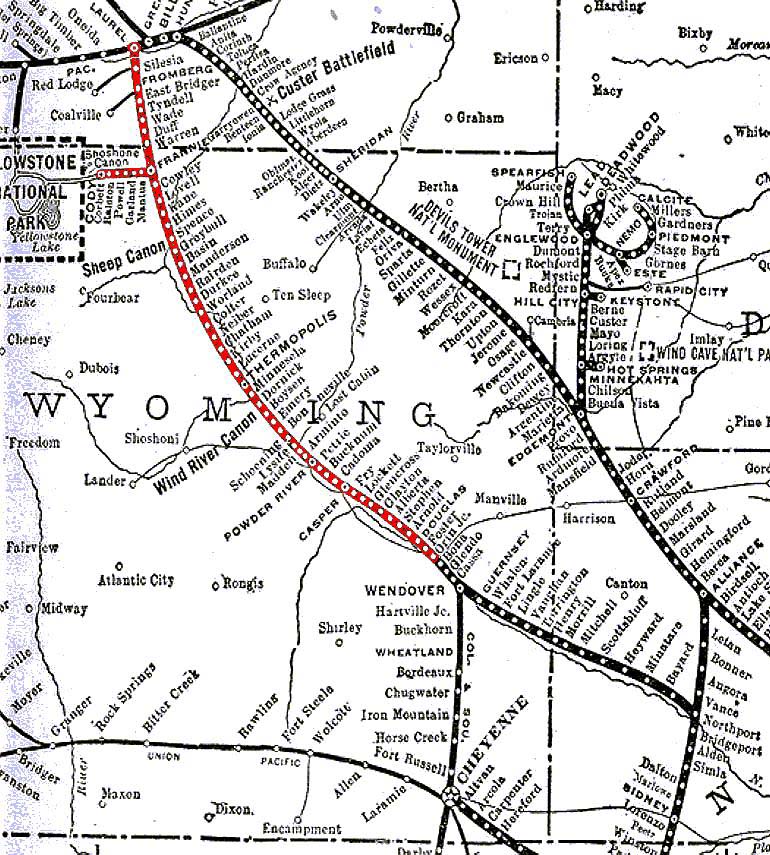
Railhead: Looking at, and for, railroad maps. Blog Mirror: Welcome to The Chicago, Burlington & Quincy Railroad in Wyoming!

Railhead: Looking at, and for, railroad maps.: A long time ago, I published this item, which I'll post in its entirety down below, regarding a railroad map from 1916.  I could not lon...

I was sent this great model railroad website:

 Welcome to The Chicago, Burlington & Quincy Railroad in Wyoming!

Wow, what a model layout.  It's fantastic.

Included on it, is this map, which we're directly linking in.:


Look at the pile of named spots on the rail line.

Some of these I recognize, some I don't.  The Colorado and Southern rail line from Glendo to Cheyenne is now a Burlington Northern rail line, I'd note.  The line running right up to Yellowstone National Park is a complete surprise.

The line running from Arminto in this depiction does not go into Shoshoni, and avoid the Wind River Canyon.  I was unaware that had been done.

Really interesting.

As are the model lines that this fellow is putting together.

Big Boy, World's Largest Locomotive, Leaves Cheyenne March 29 For Coast-To-Coast Tour


Monday, January 12, 2026

Looking at, and for, railroad maps.

A long time ago, I published this item, which I'll post in its entirety down below, regarding a railroad map from 1916.  I could not longer find it, but the item noted that later maps demonstrated the same thing.  Here's one I found from 1918.


Ths map also covered motor vehicle highways, which I was also going to try to look up.  Frankly, the highways are much easier to read.
Lex Anteinternet: Wyoming Railroad Map, 1915: The Wyoming State Library has published a series of historic maps of the state, including railroad maps.  I'd been hoping to find one fo...

Wyoming Railroad Map, 1915

The Wyoming State Library has published a series of historic maps of the state, including railroad maps.  I'd been hoping to find one for 1915 (book research, which I've been turning to again, which probably makes this blog a bit more like it originally was, and a bit more dull for the few people who actually stop in here), and low and behold, they had one.

1915 Wyoming Railroad Map.

Interesting map, it shows some things that I'd wondered about.

It shows, for one thing, that Casper was served by the Burlington Northern, which I new, and the Chicago and North Western, which I sort of knew, but it was celled the Great North Western in its later years.  It served Casper up until probably about 25 years ago or so.  There's hardly any remnant of it here now, and its old rail line here was converted to a trail through the town.  The old depot is a nice looking office building, but I don't know if that building dates back to 1915.  I doubt it.  I don't think that the Burlington Northern one isn't that old either.

 
Former Chicago and North Western depot in Casper.

 Burlington Northern Depot in Casper.

A really interesting aspect of this is that it shows two parallel lines actually running from where the railroads met in Douglas.  I knew that there were two depots in Douglas, and I knew there were remnants of the North West line east of town, but I didn't realize that the two lines actually ran astride each other, more or less (within a few miles of each other), from Douglas to Powder River, where they joined. The depot at Powder River is no longer there.

 
Former depot for one of the railroads in Douglas, now used as a railroad interpretive center.

 
 The other depot in Douglas, now a restaurant called "The Depot".

After that, interestingly, the Chicago and North Western ran to Shoshoni, while the Burlington Northern did not.  Now, a local short line runs to Shoshoni and links in somewhere with the  BN, but I don't know where.  Not in Powder River, that's for sure.  The BN still runs north through the Wind River Canyon, however, taking a turn at Shoshoni, which did not at that time, still passing through Lysite as it then did.  No rail line runs from Shoshoni to Riverton, and on to Hudson and Lander like this map shows.  And as with one of the Douglas depots, the old Riverton line is now a restaurant, although I've apparently failed to photograph that one (note to self, I suppose).  It's pretty amazing to think, really, that Fremont County's rail service has really declined pretty significantly in the past century, with Lander no longer being a terminus.  

Rail facilties in Lysite, which are probably nearly as old as the map being discussed here.

Going the other way, the results are even more surprising.  Orin Junction is still there, and is still a railroad junction, but just for the Burlington Northern.  The railroad still runs east to Lusk, but that's a Burlington Northern line today, apparently running on the old path of the Chicago and North Western.  Going south east, that line is still there up to Harville, but from the there what's indicated as a Colorado & "South 'N" line is now a Union Pacific line.

I honestly don't know, and really should, how far south that UP line runs, which shows that this is one of those areas of my state's history and present that I don't know that much about.  It's funny how something like this can really surprise you, and make you realize that you don't know aas much as you think.  I know that the BN runs as far south as Chugwater today, and further south than that, but I don't know if it runs into Cheyenne like it once did (or rather the Colorado did).  The main line of the UP runs through southern Wyoming and there's a huge yard in Cheyenne, so presumably there's a junction there somewhere.

The former Union Pacific depot in Cheyenne, now, of course, a restaurant and a museum.

This map in fact answered a question for me which I had, which is that if you wanted to travel from Casper to Cheyenne on a timely basis, what route would the train take. Well, now I know.  In 1915, you'd take either of the railroads serving Casper east to Orin Junction, and then take the BN south to Hartville.  From there, you'd take the Colorado south to Cheyenne.  From there, the extensive UP lines opened up the path west, south and east.

It's also interesting to see some lines that I knew once existed, but which are now defunct, shown here on the map.  The Saratoga & Encampment, for example, is shown.  I didn't know it was that told, but I should have.  The Colorado & Eastern running from Laramie up to the Snowies is also shown.  I knew that some railroad had done that, and that the lines are still there (a shortline serving skiers was attempted a few years ago, but no longer runs), but I didn't know what line that was.

Very interesting stuff.

__________________________________________________________________________________

Postscript

Out of curiosity, I took a look at the map for 1930, the last one they had up.  The rail lines were the same in 1930 as they were in 1915.

That shouldn't, I suppose, surprise me really.  For one thing, all the basic service lines appear to have been in by 1915 (or earlier, I'll  have to see if there's an earlier rail map).  And the last 1930 map was a "travel" map, not specifically a rail line map, like the 1915 one was, so perhaps it may have omitted any newer lines, although I doubt it.  Of interest, that travel map for 1930 only showed rail lines, not roads, so the presumption was obvious that if you were going to be doing much traveling, it was going to be by rail. 

Postscript II

Another thing that occurs to me from looking at this map is the extent of rail service, particularly passenger service, but all rail service in general, at a time when the state's population was less than half of what it present is. Very extensive.  Quite a remarkable change, compared to now, when some of these lines and many of the smaller railroads no longer exist here at all.

Of course, that no doubt reflects the massive changes in transportation we've seen, the improvement of roads, and of course the huge improvement in automobiles over this period.


Saturday, January 10, 2026

Sleeper Cars.

I've started to look into sleeper cars a bit, connected with the purpose of Lex Anteinternet.   In doing so, I've learned that I don't know hardly anything about them.

Pullman sleeping car, late 19th Century, early 20th Century

For one thing, I didn't know that they were an introduction, in the US, via George Pullman, of the Pullman Company.  I was aware of Pullman porters, an all black occupation, but I guess I never put the two together.

I also didn't realize how spartan they could be, as i the photograph from above.  My mental image of them is really based on movies like North By Northwest, which depicts really nice and private ones, and there were pretty luxurious sleeper cars at that. But there were also pretty plain ones, which makes sense in the era when town to town transportation was by train.  Not everyone was on a holiday by any means.

Another thing I didn't appreciate really is that the cars usually didn't belong to the railroad itself  One website on the Union Pacific notes:

How many sleeping cars did UP own over its lifetime? A quick answer would be 55 heavyweight clerestory-roof sleepers, and 191 lightweight sleepers. But a definitive number has two important considerations; the difference between operated, leased, and owned, and the difference between heavyweight and lightweight.

The difference between a heavyweight car and lightweight car is mostly the era it was built, rather than the material it was built from, meaning that cars of an earlier era were built with heavyweight materials, while newer, more modern cars were built using lighter materials. Heavyweight cars were built using riveted carbon steel body-frame construction, and concrete floors. Most were built in the 1910s and 1920s and due to their weight, were equipped with six-wheel truck and wheel assemblies. These have been known as heavyweight cars since the 1940s to distinguish them from the lightweight cars built using either much lighter aluminum or welded alloy steel, or combinations of both. Lightweight cars had non-opening windows, and full-width arch roof. Most were built after 1935 and were equipped with four-wheel truck and wheel assemblies.

Union Pacific did not own any sleeping cars until the government's forced breakup of Pullman in 1944. Until that date, all lightweight sleeper cars used by Union Pacific on their trains were "operated" by UP, but owned by The Pullman Company. After that date, sleeper cars operated on UP trains were either owned by UP, or owned by UP and its SP and C&NW partners; all were leased back to Pullman for operation.

I should have known that.

Pullman's hold on the industry was so pronounced that sleeping cars used in World War One belonged to them.


All of this no doubt just scratches the surface of this topic, about which I'm nearly completely ignorant.

Monday, October 6, 2025

Towns and Nature: Dubuque, IA: Lost/CGW Depot

Towns and Nature: Dubuque, IA: Lost/CGW Depot: ( Satellite , as is rather typical, the depot's land got used by a highway. It looks like the Milwaukee tracks have also been moved in t...